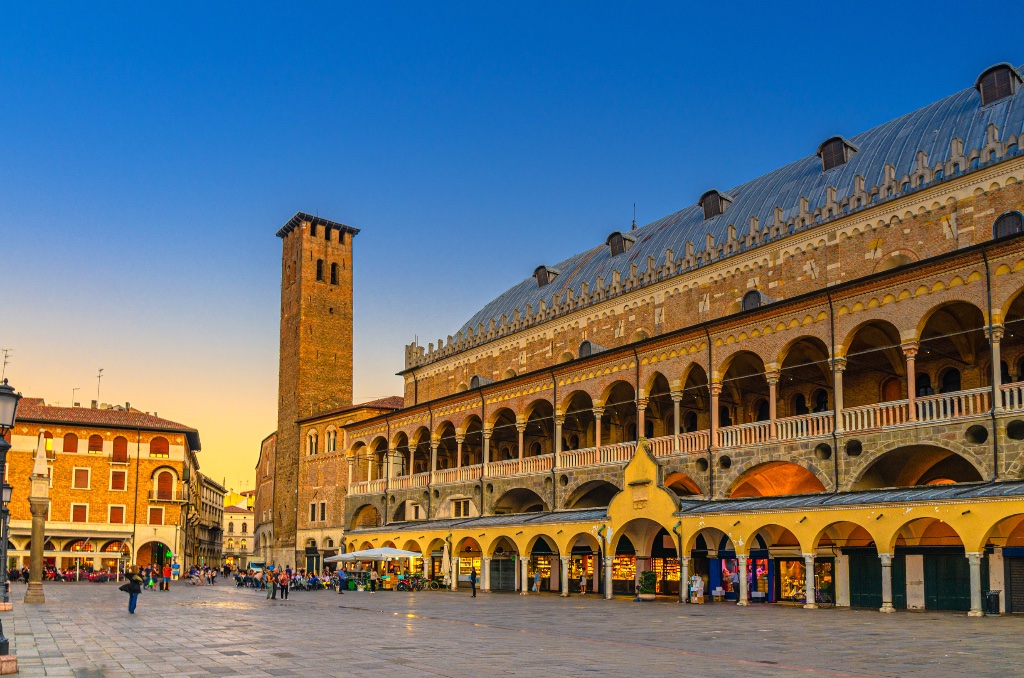
Padova, one of Italy's oldest cities, traces its roots to the 12th century BCE. According to legend, the city was founded by Antenor, a Trojan prince who fled Troy after its destruction. His supposed tomb can still be seen in the city. Today, Padova is a dynamic economic and cultural center with ~210,000 inhabitants, of which ~60,000 are University students.
Ancient Origins & Roman Heritage
Archaeological evidence confirms that a settlement existed around the 10th century BCE, likely inhabited by the Veneti people. In 45 BCE, Padova became a Roman municipium, flourishing as a major commercial and cultural hub in Northern Italy. It was known for its agriculture, horse breeding, and wool production. However, with the fall of the Roman Empire, Padova suffered barbarian invasions, notably by Attila the Hun in 452 CE.
The Middle Ages & Renaissance
During the Middle Ages, Padova became part of the Holy Roman Empire but experienced a turbulent period with internal struggles and conflicts with neighboring cities. In the 13th century, it saw cultural and architectural growth, notably with the foundation of the University of Padova in 1222, one of the oldest in the world. This institution attracted great minds, including Galileo Galilei, who taught there.
The city thrived under the rule of the Carrara family (14th century), who turned Padova into a Renaissance center. However, in 1405, the Republic of Venice annexed Padova, ushering in a period of relative peace and artistic splendor. After Venice's fall in 1797, Padova passed under Austrian control until it joined the Kingdom of Italy in 1866.
Curiosities & Legendary Stories
- ✦Saint Anthony's Miracles — One of Padova's most beloved figures is Saint Anthony of Padua, a Franciscan friar known for his miraculous deeds. His basilica is a major pilgrimage site, and legend says his tongue remained incorrupt after death.
- ✦Galileo's Pendulum — Galileo Galilei, who taught in Padova for 18 years, is said to have studied the movement of a lamp in the Basilica of Santa Giustina, inspiring his pendulum theories.
- ✦The Ghost of Caffè Pedrocchi — This historic café, once a meeting place for revolutionaries, is rumored to be haunted. Patrons have reported ghostly whispers and sudden cold drafts.
Main Attractions
- 1Basilica of Saint Anthony — A grand church with impressive domes and the tomb of Saint Anthony, one of Italy's most visited pilgrimage sites.
- 2Scrovegni Chapel — Home to Giotto's frescoes, considered a masterpiece of Western art. Painted in 1305, now a UNESCO World Heritage Site.
- 3Prato della Valle — One of Europe's largest squares, featuring a canal and 78 statues — a stunning open-air monument to Padova's history.
- 4University of Padova — Established in 1222, its historic Anatomy Theatre is a must-see — one of the world's first permanent dissection theatres.
- 5Palazzo della Ragione — A medieval town hall with a spectacular wooden ceiling, dominating the heart of the old city.
- 6Botanical Garden — The world's first botanical garden, founded in 1545 and still in operation — a UNESCO World Heritage Site.
Padova is a city where history, legend, and art merge into a unique cultural experience. With one of the world's oldest universities, priceless medieval frescoes, and a vibrant student atmosphere, it remains one of Northern Italy's most rewarding destinations.
Gallery