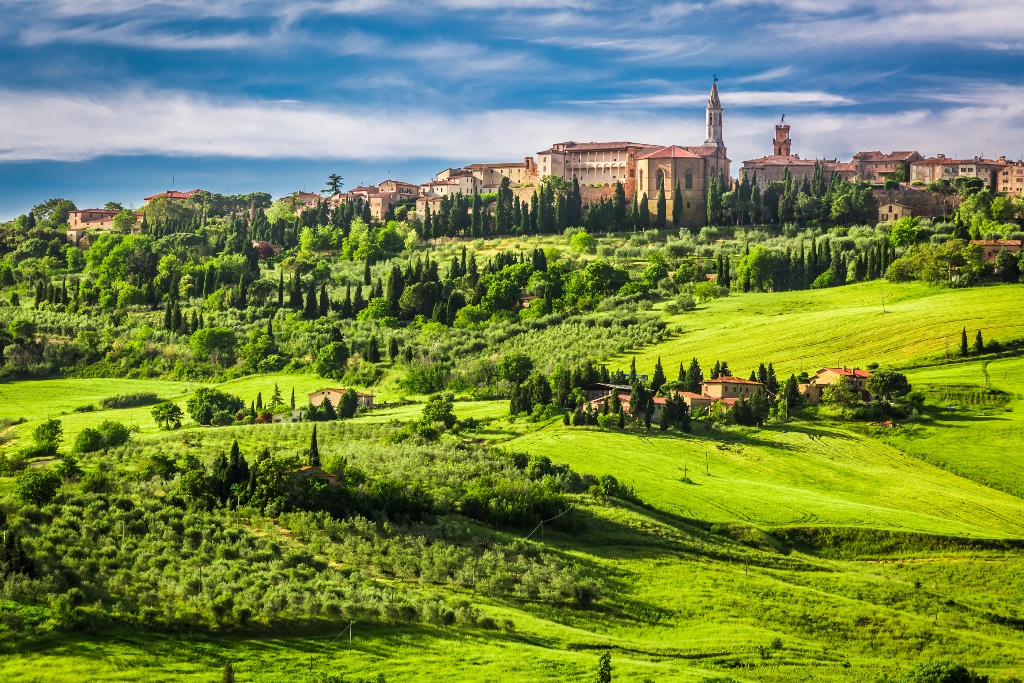
Pienza, a charming hilltop town in Tuscany, is often called the "ideal city of the Renaissance." It was transformed in the 15th century under Pope Pius II, who envisioned it as a model Renaissance town — a vision so complete it was achieved in just four years.
A Pope's Dream City
Pienza's history dates back to Etruscan and Roman times. The town gained prominence when Enea Silvio Piccolomini, a Pienza native, became Pope Pius II in 1458. Determined to rebuild his birthplace, he commissioned architect Bernardo Rossellino to design a harmonious, humanist city reflecting Renaissance ideals. In just four years (1459–1462), the town was transformed, creating a stunning example of urban planning. Unfortunately, Pius II died in 1464, halting further development.
Legends & Curiosities
- ✦The Ghost of Pius II — Legend has it that Pius II's spirit roams Pienza, admiring his beloved creation. Some claim to feel his presence near the Piazza Pio II, especially on misty nights.
- ✦Pecorino di Pienza — Pienza is famous for its sheep's milk cheese enjoyed since ancient times. Even Pope Pius II praised it in his writings — a culinary legacy as enduring as the architecture.
Main Attractions
- 1Piazza Pio II — The heart of Pienza, this square embodies Renaissance symmetry and is the centerpiece of Rossellino's masterplan.
- 2Pienza Cathedral (Duomo di Pienza) — A masterpiece blending Gothic and Renaissance styles, featuring stunning frescoes and an unusual tilting structure due to soil shifts.
- 3Palazzo Piccolomini — The former papal residence with a breathtaking view of Val d'Orcia. It was used as a filming location for Franco Zeffirelli's Romeo and Juliet (1968).
- 4Walkways & Viewpoints — Pienza offers spectacular panoramic views of the Val d'Orcia, a UNESCO World Heritage site since 1996.
Pienza remains a symbol of Renaissance vision, blending history, culture, and nature in a breathtaking Tuscan setting. A UNESCO World Heritage Site and one of Italy's most perfectly preserved hilltop towns.
Gallery