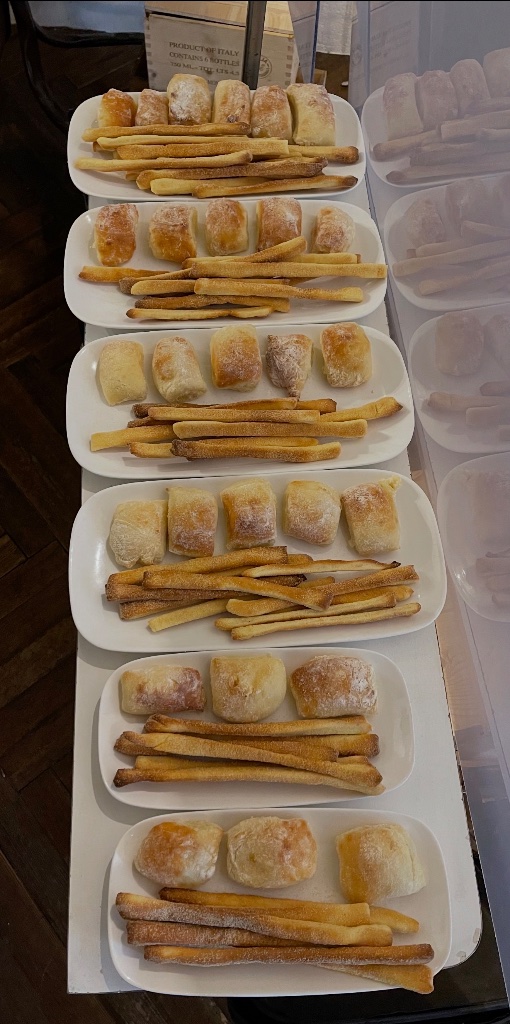
Long before Turin became known for industrial powerhouses or contemporary art spaces, it earned an obsession from European royalty for something far simpler: flour, water, lard, and yeast. The grissino is perhaps Turin's most successful culinary export, yet outside of Piedmont, true artisanal breadsticks remain largely misunderstood, often confused with dry, machine-extruded factory crackers.
In Turin, however, the breadstick is a matter of pride, technique, and daily ritual. From noble courts to neighborhood forni, the tradition of hand-stretched dough remains a living craft across the city's historic center.
Napoleon Bonaparte was so enamored with Turin's breadsticks that he established a dedicated courier service to transport "les petits bâtons de Turin" directly to the Tuileries Palace in Paris.
The Royal Diagnosis: Invention of the Ghersin
Legend and archival records trace the invention of the grissino to 1679. Antonio Brunero, a baker from Lanzo Torinese working under the direction of the Savoy court physician Teobaldo Pecchio, was tasked with creating a highly digestible bread for young Duke Victor Amadeus II. The future King of Sicily was frail and unable to digest the soft, damp crumb of traditional loaves (ghersa).
Brunero adapted the local bread formulation by stretching the dough exceptionally thin before baking, ensuring the humidity evaporated completely. The result was a crisp, light, and long-lasting bread stick: the ghersin, which later evolved into grissino.
The innovation solved the royal health crisis, but more importantly, it introduced a staple that resisted mold in humid storehouses, making it an instant hit across all social classes in Piedmont.
Rubatà vs. Stiratì: The Local Distinctions
Ask an authentic Torinese baker about breadsticks, and you'll immediately learn that not all grissini are created equal. The local culture distinguishes two main traditional varieties:
- Rubatà (The Knotted Original): Originating from the Chieri area just across the Turin hills, rubatà (meaning "fallen" or "rolled" in Piedmontese dialect) is hand-rolled with heavy palm pressure. It produces a dense, knobby breadstick about the thickness of a finger, featuring a rich, toasted flavor and a slightly rustic crunch.
- Stiratì (The Stretched Masterpiece): Developed later in the urban bakeries of Turin, stiratì is stretched by the baker pulling the dough at arm's length. This technique creates a longer, airier, and exceptionally crispy breadstick with delicate air pockets inside.
While industrial production popularized straight, uniform breadsticks globally, local Torinese tradition strictly values the irregular, hand-shaped contours of authentic rubatà and stiratì.

Turin Essentials
The hand-curated Turin guide
A unique digital journey through the first capital of Italy, written by locals, not scraped or AI-generated.
Discover the GuidePractical Factsheet & Local Bakeries
- Origin Year: 1679 (Savoy Court Bakery, Turin/Lanzo)
- Core Ingredients: Type 0 flour, water, lard (or olive oil), yeast, salt, malt
- Traditional Varieties: Rubatà (rolled/knobby) & Stiratì (stretched/airy)
- Historical Hotspot: Panetteria Perino Vesco (Via Juvarra 24)
- Artisanal Icon: Panificio Ficini (Via Saluzzo 82, San Salvario)
How It Compares: Authentic Bakeries vs. Modern Aperitivo
In Turin's food scene, how grissini are served dictates the authenticity of the establishment:
- Traditional Trattorie & Piole: Authentic spots serve un-packaged, hand-stretched grissini wrapped in paper sleeves or placed directly on the tablecloth alongside local antipasti like Vitello Tonnato or Salsa Verde.
- Supermarket & Factory Alternatives: Mass-produced versions rely on palm oil, vegetable oils, and extruded dough techniques, resulting in a uniform texture that lacks the aromatic depth of lard-baked stirata.
- Modern Aperitivo Venues: High-end cocktail bars across Centro and Gran Madre pair fresh rubatà wrapped in aged Prosciutto di Parma or Culatello, leveraging the crisp texture to contrast rich cured meats.
Verdict: Skip pre-packaged restaurant baskets and seek out local panetterie in neighborhoods like San Salvario or Quadrilatero for fresh daily bakes.
Local Tips for an Authentic Tasting Experience
If you want to experience Turin's breadstick culture like a local, keep these key points in mind:
1. Look for the Irregularities: True hand-stretched grissini are never uniform. Look for varying thickness, slight twists, and dark toasted spots along the length, signs of genuine manual labor. 2. Mind the Lard (Strutto): Traditional recipes use high-quality lard (strutto) for crispness and shelf life. If you are vegetarian or vegan, always ask the baker for grissini all'olio d'oliva (olive oil version). 3. The Paper Bag Rule: Never store fresh grissini in plastic bags, as humidity makes them chewy. Keep them in open paper bags at room temperature to preserve their signature crispness for days.
Sources & References
- Accademia Italiana della Cucina: Historical documentation on the Savoy court diet and 17th-century Piedmontese baking methods.
- Città di Torino, Archivio Storico: Historical records regarding court physician Teobaldo Pecchio and baker Antonio Brunero.
- Guida Gambero Rosso, Pane & Panettieri d'Italia: Quality criteria, bakery ratings, and traditional production standards across Turin.
Keep Reading
Juventus
No More Paper Tickets: Inside Allianz Stadium's Digital Revolution
Read
Travel Tips
Is Turin Safe? A Practical Guide for International Visitors
Read
Things to Do
The National Automobile Museum: Why It Is One of Turin's Best Attractions
Read
Travel Tips
Turin Caselle: The Fastest-Growing Airport in Italy
ReadThis article reflects our personal knowledge and first-hand experience of Turin. It is intended as a helpful starting point and inspiration, not an exhaustive or definitive guide. Places, prices and details may change over time — we recommend double-checking directly with the source before making plans.
Around Turin Experiences
Live Turin like a local
Curated food tours, tastings, stadium visits and unforgettable moments — handpicked by our team.
Explore Experiences